Tuesday, March 9, 2021

Thee Busy Bee Has a Website!!!


Hey look, that's me Thee Busy Bee and guess what?? I have my very own website now full of STEM teacher resources, information on how to use a Cricut Machine and a 3D printer, wardrobe options, reviews annnnnnnd I have a store! 

Click the image above to get to it...or just click here! I hope to see you there!!!

Sunday, August 30, 2020

Thee Busy Bee Teaches Virtually!!


Ok first of all, that's me, and absolutely Black Lives Matter!! Just in case you were wondering, yes...I still teach and yes, I'll be teaching from home this year!! Here's a snapshot of my virtual classroom for this year. Of course, all of the links are live for my students...this is again a snapshot. :)  If you have any questions on how to set up one of your own drop me a line. 


Thursday, August 8, 2019

Middle School Science

The Shift

clipartstation.com
Thee Busy Bee no longer teaches elementary school friends, I now teach middle school ones. Although I'm working with a different age group, my goals for STEM education have remained the same, and I still teach in the same county. I've been teaching middle school science for 3 years and have had the pleasure of teaching 6th, 7th and 8th grade students. I enjoy what I do now more than ever because I finally have the opportunity to teach nothing but science all day long, what more could I ask for? One of my primary reasons for leaving elementary school was because I wasn't able to teach science nearly as much as I wanted to, nor did time given allow for it. In middle school, it's a class by itself so there's no circumventing science education, one stipulation I love.

The Difference

http://emorygdbbsnews.com/
You may think teaching middle school students would be different from teaching elementary school students but really its not. At least not very much. Both age groups can and want to learn, both are dealing with growing pains and both still have quite a bit to learn. The biggest difference between  elementary aged children and middle school aged children is their age and their age of course reflects the types of behaviors they may participate in. I've also found middle school students to be more verbally expressive than elementary school students. They're older, and in most cases wiser which can lead to a host of variations. I've found some of them to be convincingly manipulative and cunning, sometimes for seemingly minute reasons, especially towards students and teachers they don't like. Unfortunately some of the same reasons why I like teaching children this age are some of the are reasons I don't. I've been cursed at, shoved, recorded without my consent and verbally attacked in other ways during these three years, something I never experienced and would have never imagined while teaching elementary aged children. Elementary aged friends are much kinder and respectful than their middle school counterparts and most middle school students get to middle school and act as if they've forgotten everything they learned in elementary school...including their manners. On the other hand, thankfully the majority of the middle school students I've taught have been eager to learn, respectful and hardworking.

The Payoff

The best thing about what I do is what I do. I'm a middle school science teacher! I get to dispel flat earth and other humorous theories, make things smolder and smoke and teach the future something new everyday. Science as a subject is like none other. It's the only subject that can change it's history. Science, unlike many of the other subjects, is not fixed; new inventions, ideas and ways at looking at previously researched phenomena are discovered everyday. Concepts taught in previous years may be invalid this year, and making sure what you're conveying is current keeps a great science teacher on their toes. Another reason why I enjoy doing what I do is because I love science and learning new things. I have notebooks upon notebooks full of notes and diagrams all related to science concepts I teach or have taught in the past. Some of these diagrams I've actually had made into posters I display in my classroom. The purpose of recording the notes I have is so I can answer as many questions as possible (before telling them "I don't know so let's figure it out together."), and since starting these notebooks, I haven't come across too many content related questions I can't answer. :) When planning to teach an unfamiliar concept I research and take notes on it and aim to gain a college level understanding of it, then I assess myself on the concept in a variety of ways and create some type of digital organizer to display key or difficult points. Then and only then can I consider myself ready to teach it to others. What do I gain? I gain a wealth of new information about a novice concept!! What do my students gain? Everything!

-Thee Busy Bee


Thursday, May 19, 2016

Blended Learning: Self Guided Natural Resources Unit


Have you ever heard or tried Blended Learning?? Well, if you have, or even if you haven't, this unit may interest you!! My scholars are studying Natural Resources. It is also testing time. As most educators know, not much instruction can take place on those days. But what if you could continue instruction, without having to do much more than facilitate a few times at the start of the lesson?? Look no further than the idea of blended learning.


Monday, April 18, 2016

Front Row Education for School and Home!!


Front Education is a necessity for all k-8 educators! I've been using Front Row in my classroom for over two years to support our blended learning environment. It has become a permanent portion of my scholar's daily schedule. We use it to reinforce our basic fact knowledge, practice skills we've been introduced to in class and enrich and accelerate our self-guided instruction. As a result of our daily use, students in my class consistently outperform their counterparts in other third grade classrooms on both of the district assessments administered in overall growth. Most of my students know how to add, subtract, multiply and divide fractions with like and unlike denominators, which is a fifth grade concept. These concepts weren't introduced to them by me but by their use of Front Row's adaptive practice! at school and at home!! I've also observed an increase in my student's interest in informational texts

What is Front Row? In short, it's an academic application that challenges students on Reading, Language Arts and Math Common Core Standards and allows teachers, parents and administrators to track student progress effortlessly. 

Want to learn more?? Watch the video below!!


What children see:


What happens as a result!! (Based on case studies) 


What you can do:
Click here to learn more about what Front Row Education can do for you!!

Are you a parent?? Click here to sign up and use parent features!!

Or, of course, you can ask me!! :)

-Thee Busy Bee
Front Row Ambassador!! (Who knew?? Now you!!)


Monday, July 28, 2014

How-To Design and Implement a STEM Lesson Professional Development Opportunity!!


"How-To" Design a STEM Lesson from Start to Finish: A Professional Development Opportunity


Background:

This Professional Development opportunity is for any and everyone wanting to know more about how to create and implement a STEM Lesson or Challenge from start to finish. The modules below can be looked at separately or at once in succession, which is my suggestion, as the topics are written around one central lesson plan on insulation.  Please do challenge yourself to watch each of the short videos, read the clarification statements and complete the accompanying exit questions. Exit question answers are for you, however if you'd like feedback on them, please submit your answers to theebusybee@gmail.com!! 

Also, if you don't mind, please, please complete the survey at the end of your training. This information will help me improve future Professional Development opportunities. Thank you in advance!!


To participate in the Professional Development opportunity click here!!

Your friend in STEM,

Thee Busy Bee 

Tuesday, June 10, 2014

Loops and Drops!! A STEM Roller Coaster Design Challenge


The school year is winding down, yet again...but my friends and I hadn't noticed!! Today we used what we already know about momentum, friction and gravitational force to design and create roller coaster prototypes. The goal of this project was to not only have fun but to reiterate important physcial concepts such as the ones I mentioned before, and balance and stability, something I taught my little ones about in the begininng of the year while discussing their effects on bridges.
 
 
What did I use to project the awesomeness (yes, awesomeness) and intricacies of roller coaster design? The epitome of roller coasters, Kingda Ka. Kingda Ka is the fastest coaster in North America, going from 0 to 128 miles per hour in just 3.5 seconds! But what perhaps is even more impressive than Kingda Ka's speed is its sheer height, at a collosal 456 feet, it is the tallest roller coaster in the world. See for yourself!!


But enough about Kingda Ka...check out some of our work!!!

Photo
PhotoPhoto
Photo
Photo
PhotoPhoto


This challenge and ones like it continuously require your students to problem solve and think critically, two exceedingly neccessary traits of great students, and eventually successful professional adults. Students had to consider several entities of structure design like weight and balance, but they also had to consider the overall "fun" appeal of their coasters, in order to complete this challenge.


Have fun and as always, flipchart resources are here and the challenge sheet is here!!

Your friend in STEM,

Thee Busy Bee


Wednesday, May 28, 2014

Lend a Hand!! A Materials/Bio STEM Challenge!!

Challenge Specifics
 
We've been investigating living organisms, their habitats, natural resources and the relationships between all three. I challenged each student to design and contruct a prosthetic device to be used by someone without the use of all of their fingers. This we know is a medical problem that biological and materials engineers solve everyday, using natural resources (or some variation thereof) and what they know about the science behind how prosthetics work. Now some might say that since my little friends don't have the scientific background knowledge neccessary to complete such a task, that they wouldn't be able to...but I beg to differ. Most of what we need to know about how this world works, we learned as babies. Children have the ability to do all sorts of things, if we just give them the materials and let them go.
Photo 
Prosthetic example!!
Photo

I didn't tell my students how prosthetics worked, nor did I show them any pictures of any. I didn't explain anything to them about wedges, inclined planes, springs or support. I simply gave them the materials, a sheet detailing specifics and told them to have a fantastic weekend!! Although I didn't discuss any of the aforementioned concepts with them, all of my friends used some variation of those physical ideas in order to complete their challenge designs. How??

Well, here's an example, I asked this student about the logistics of her design and she explained to me that she got the idea from a seesaw. She described to me the way a seesaw works and pointed out the fact that since it works there, why not here...so cute!! Her grabber was able to pick up a cotton ball, a sheet of paper, an eraser and a penny!! 
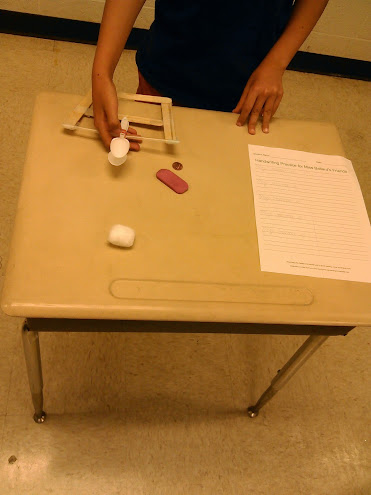


This student said he came up with his idea after thinking about the motion of a person's hand moving up and down, while watching his mother cook dinner. He explained that he noticed a continuous up and down motion, that he wanted to immitate in his design. He also discussed the actual look of his design and how it lends itself to convenience and conveys the feel of a real hand. His grabber was able to pick up a cotton ball, a sheet of paper, an eraser and a penny as well!! 


Here are a few other designs!!

PhotoPhoto
Photo

The bottom line, challenge your little friends without having the end in sight. Let them find their way through observations made through success and failure!!! And as always...here's a link to the actual challenge, the specifics and a letter you can send home with a rubric attached!! :)
 
Your friend in STEM,
 
Thee Busy Bee 

Friday, May 16, 2014

Coordinate a STEM Night!!


How-To: Coordinating a STEM Night at Your School
Ever wanted to organize a night dedicated to STEM at your school?? Well, this school year at my school, I had the pleasure of co-coordinating one such event…it went swimmingly, thanks to fabulous minds and fantastic planning. Here’s how we did it!

Planning Your STEM Night

This is the very first step in the organization process…well besides the obvious choosing to conduct a STEM night in the first place. J Having a precise plan can be beneficial for implementation and recording this information is even better. The following is a table giving details you may want to take into consideration when planning your night:

Do This:
  • Start early! I can’t stress this enough. Great events take great planning and great planning takes great time….period. The more time you give yourself to prepare, the better!!
  • Solicit volunteers from inside of your school and out. This can be done in a variety of ways, like email invitations, e-vites, online surveys and traditional tried and true papers sent home to students. Preferably, find volunteers who have STEM backgrounds and are passionate about STEM education…it’ll make a huge difference in the way activities are facilitated. People who love science, engineering, technology and/or math are great options as well!!

  • Develop fun and engaging activities for parents and students to complete. There are numerous online resources to assist you in this department, but why search through all of them when you can just email me directly for a list of over 50 STEM challenge ideas at theebusybee@gmail.com or at totallySTEM@gmail.com J I can provide instructions on what needs to be done as well.

  • Schedule and create rotations for families. This helps keep families and volunteers organized and it assists in keeping families from lingering in one activity area for too long or not staying long enough in another.

  • Advertise. Advertisement of events like these not only inform potential participants about logistics, they also can serve as a reminder and a way to keep people enthusiastic about participating.

  • Secure locations for activities to take place. In order to hold an event of this nature, you must have areas in which to conduct. I’d suggest using rooms that are all on the bottom level of your facility. By doing this you will cut down on the amount of traffic to areas where there is no supervision. This also keeps everyone volunteering in the event close to each other in the event that they need assistance from one another.

  • Locate sources for materials to be used. The great thing about many STEM challenges is that they usually don’t require much in the area of materials. Supplies for many STEM activities can be found right in your very own home. However, some resources will need to be purchased. Small grants are fantastic, but when in a crunch, sending a note home with students asking for donations can yield fantastic results.


Carrying Out Your Plan

When carrying out your plan be sure to make a nice to do list to help you stay on track, that can be shared with volunteers if need be and your administrative team. This will allow participants to see your vision and where they fit in in assisting you in making it come to fruition. It’s also nice to give yourself deadlines for task completions, which will also assist you in staying on schedule, so don’t be reluctant to do so. The following table gives an example of a “To-Do List” for carrying out a plan for a STEM night event.

Sample STEM Night To-Do List:
1. Obtain approval for holding the event from administrative team no less than 5 months in advance for logistical purposes
2. Inform school staff of the event two months before its scheduled date and ask for staff volunteers
3. Secure locations for activities to take place at least one month before the event
4. Solicit volunteers from outside of the school at least one month before the event
5. Develop STEM challenges and accompanying resource sheets to be completed that night at least one month before the event
6. Ask parents and community partners for materials at least a month before the event
7. Purchase materials not donated at least two weeks before the event (especially if items are to be ordered)
8. Create a schedule for volunteers and a rotation schedule for families to follow while there, at least two weeks before the event
9. Advertise as much as possible from beginning to end and one of these fliers should have a place for probable participants to RSVP
10. Copy all paper resources for that night at least a week before the event
11. Assemble and distribute materials to volunteer participants the day before the event
  
Facilitating the Actual Night

When the big night finally arrives, smile, pat yourself on the back and watch your vision come true! But before it actually starts, there are a few strings that need tying. The day before the event would be the ideal time to double check your to-do list and to double check with participants to make sure they’re still volunteering, just in case you need to make any last minute adjustments. It’s best to give yourself as much time as possible so you can stay one step ahead of the game. The following table is a list of some logistics you might want to consider that night, just to make sure everyone has fun and that everything runs smoothly.

Do This:
  • Assign two to three people to the main entrance of your facility to serve as greeters….encourage them to smile and to exude enthusiasm about the event

  • Assign four-six (depending on school size) people to serve as guides for families who have trouble finding their way to their activity areas

  • Make sure families are given schedules when they come in the door

  • Make sure families stay in the areas they are supposed to until their transition times

  • Announce transition times on a loudspeaker

  • Complete a walk through right before the event starts just to make sure everyone and everything is in place

  • Start promptly and end promptly

  • Encourage volunteers facilitating activities to have fun, smile, be warm and to relate activities to real life instances as much as possible


As always, please feel free to direct any questions you may have to theebusybee@gmail.com or totallySTEM@gmail.com and I’ll get back to you. Need help?? Totally STEM can do that, we can even come out to your event and facilitate a challenge! Best wishes!!! J
  
Looking for More???

·        Offer refreshments and ask that they be consumed in a designated area

·        Distribute goodie-bags for families to take home with a STEM challenge and materials for it inside

·        Give a brief introduction to all parents about STEM, STEM challenges for children and STEM education implications on later life

·        Serve dinner for volunteers


Tuesday, March 18, 2014

Thee Busy Bee's Perspective of STEM


STEM History

Science, Technology, Engineering and Mathematics make the world go…literally. Where would we be had it not been for the discovery of penicillin by Scottish scientist Alexander Fleming in 1928? Through tedious hours of scientific experimentation, analysis and observation Fleming was able to conclude that if this particular form of mold, Penicillium rubens, were grown in adequate conditions, the byproduct would have antibiotic like properties. Although he’s not credited with suggesting penicillin use in treating bacterial infections in humans, (that attribution goes to the Australian biologist Howard Walter Florey, German biologist Ernst Chain and the English biochemist Norman Heatley) we can certainly thank him for laying the groundbreaking foundation. And what of the Great Pyramids of Giza, one of the last known Wonders of the World?? We would have never been granted the opportunity to witness the finality of such great structures had it not been for the architectural genius of our predecessors like the great Imhotep of Ancient Egypt.
Imhotep used his knowledge of mathematical ratios, materials, what we now know as architecture and his understanding of the physical world to construct a simple pyramid which used a stacking of materials upon others to achieve a particular height and shape, which was a totally new idea at the time.
From the construction of the pyramids mathematicians and scientist were able to manipulate those finding into a manifestation of something else…in some cases, other pyramids, and in others…the foundations for understanding Phi, the Golden Ratio, Pi, the circumference of a circle in relationship to its diameter and the Pythagorean Theorem, which is used to calculate the side lengths of triangles….all from that.

What would we know about the world above us if it weren’t for the Russian engineers and scientists who designed and constructed the very first artificial Earth satellite, which was launched on October 4, 1957? This advance took many, especially Americans, by storm and prompted a worldwide “space race” to see which country was intelligent and resourceful, therefore powerful enough to build the next successful spacecraft. This scientific feat (and others like it) urged America’s greatest minds to rethink education, especially with regards to Math and Science, in order to preserve our futures.

After Sputnik’s launch, the American education system 
saw it necessary for immediate reform, and has not looked back since. America’s leaders at that time began to fear that other countries would continue to surpass us in scientific advancements which could then lead to a clear and direct shift in power from us, to those who are smarter than us. Of all of the innovations mentioned in the first paragraph, and of many you can probably think of, none of them came to be because of us Americans, not the atomic bomb, not the periodic table and not even the name from which Nobel prizes are derived...it’s actually Swedish and named after the brilliant Swedish inventor, Alfred Nobel.  So, where did we fall short? Perhaps…instruction and expected outcomes.  U.S. President Dwight Eisenhower and other government officials saw our children losing the academic race, and knew that if the children lost, then our futures are lost as well. Most reformers at the time saw science education as a means of national security, in all ways they were correct. An investment from the National Science Foundation might have ignited the journey towards a shift in science instruction; but the launching of Sputnik embarrassed us and solidified it.

So the change began. No longer were teachers just “expected to” teach Reading, Writing and Arithmetic, teachers were now required to actually teach Science as a subject. Very shortly thereafter we saw the introduction of the Scientific Method, a process designed to give guidelines and specifications as to how one should carry out scientific experimentation. Then came national science standards, standards given as guidelines for educators teaching scientific concepts, technology standards, standards to be used in conjunction with technological innovation projects and more recently the introduction of the Engineering Design Process which like the Scientific Method, gives precise procedures to use when completing an engineering design challenge. Mathematics instruction has also seen various reformations, the most recent reform…the Common Core. But some others wondered still how can we make all of this scientific and mathematical information come together in a workable conceptual framework that can be applied to various situations?? Then came STEM.


My Perspective of STEM


STEM, which again is an acronym for Science, Technology, Engineering and Mathematics, is an integration of four subjects. STEM education is unique in that it takes pedagogy from several different disciplines and combines it into the application of something totally new. Optimal STEM instruction challenges students to work collaboratively, using critical thinking skills to creatively solve an overarching problem. The problems, which are usually referred to as challenges, are presented as relevant, everyday personal and/or global scenarios and encourage students to use an engineering design process in order to “solve” or complete them. For example, Totally STEM, a business whose main mission is to introduce as many children to STEM challenges as possible, devises STEM challenges that require students to draw upon their scientific, technological, engineering and mathematical knowledge in order to conquer a global task. One of their “challenge sheet’ specifics is below. The challenge detailed below requires students to accurately draw upon their knowledge of physical science, engineering, similar technologies and measurement in order to create a launcher with the exact specifics in the directions.


The STEM Debate

How STEM should be taught is certainly up for debate. Many people believe it should be taught with other school subjects, basically in conjunction with them, and some, like me, believe it should be taught in solitude...as a subject in itself. In a scenario like this one, Science and Math for example, would be taught in solidarity…so skills, base information, and concepts can be taught without waver so as to ensure complete understanding. If this where the case, then STEM would be taught as its own subject and during that instructional time teachers and students would only be working on application of the skills they’ve acquired in other subjects. STEM challenge activities really bring out the best in students!! STEM challenges stimulate the brain and require children, and adults for that matter, to think less superficially in order to come up with a way to complete or conquer the problem given. Moreover, STEM challenges require students to 3 C it! as I like to call it, which is a short way to include the following words into something we all can remember: Communicate, Collaborate, and Create!! If STEM is the future, the 3C's are the mechanisms we must use in order to get there. Why should we only teach students to utilize these skills during STEM activities, when they are skills that can, and should be used in all subjects, including when they are at play. In short, a consistent helping of STEM should produce students who will at some point change the world we know of today by being inventors, innovators and critically thinking problem solvers.

So when will there be another scientific/mathematical instructional reform?? I’d say right about the time when all of our troops make it home from Iraq, Afghanistan and wherever else they’re stationed.


Resources:
Barman, C. (1989). Making it work. Science Scope, 12(5), 28-31.
Bybee, R.W. et al. (1989). Science and technology education for the elementary years: Frameworks for curriculum and instruction.Washington, D.C.: The National Center for Improving Instruction.
Ramsey, J. (1993). Developing conceptual storylines with the learning cycle. Journal of Elementary Science Education, 5(2), 1-20.
Donovan, Suzanne M. & Bransford, John D. (2005). How Students Learn. Committee on How People Learn, A Targeted Report for Teachers

Tuesday, February 11, 2014

The oftentimes forgotten "E" in STEM...


Engineers help make the world go round, they solve problems and even sometimes devise new ones, just so they can ultimately solve them by creating something us humans can find useful. Some of which we can’t live without. The problem of communicating with people over long distances was solved by engineers, most notably Alexander Graham Bell.  One can only imagine how gut-wrenching waiting on important letters to be delivered by the postal service must have been prior to telephones, however engineers at heart saw that tormenting wait time as a unique problem waiting to be solved. The answer was the telephone.
 
Out of this monumental breakthrough though came the invention of the “electron tube” , an electric amplifier, in 1906 by Lee De Forest, which revolutionized long distance calling. Between 1910 and 1920 telephone ownership ballooned from 7 million to 16 million people. The majority of those phones, however, belonged to businesses. Eventually the demands of people increased (what’s new) and caused engineers to redesign those old, cumbersome and sometimes downright tedious telephones into the devices we’ve grown to love (and sometimes hate) but are ultimately committed to…cellular phones.  Pew Research Center reported in 2013 that 91% of American adults own cell phones. Even more alarming is the fact that a U.N report says that 6 of the world’s 7 billion people own cell phones, while only 4.5 billion of them own toilets…right. Regardless, the invention of the telephone gave way to what we have today and engineers made it possible. 

 
Engineers relate their knowledge of mathematics and the sciences to create and improve existing technologies. The term engineering refers to “the application of science and mathematics by which the properties of matter and the sources of energy in nature are made useful to people by designing and manufacturing complex products”.

Aerospace Engineers, for example, are experts in aerodynamics and specialize in making transportation mechanisms go faster, while maintaining efficiency. They design and carefully build fighter jets, rockets, shuttles, planes and satellites...just to name but a few. We rely on their expertise each and every time we fly. How about those flying cars??

Mechanical Engineers have a unique set of talents, since they work on making machines work, and making them work well might I add, their labors of love include an array of different fields including amusement park rides, robotics (yes, like R2D2), toys, medical devices and cars!!! We rely on their expertise in almost all facets of life, that is unless of course, you live under a rock.
STEM education relates to the integrated approach of teaching science, technology, engineering and mathematics. Most educators will agree that STEM stands for Science, Technology, Engineering and Mathematics, but we don’t always see eye to eye on how STEM should be taught. Some people think it’s best to take a “silo-approach” to creating and teaching STEM lessons, and some believe they should be taught all at once, in conjunction…I prefer the latter methodology.  I find issues with teaching a “STEM” lesson in four different parts…having a Science part, a Technology part, an Engineering part and a Mathematics part, to me, seems to defeat the entire purpose of what STEM education is...an integration. Moreover how would that look? Either way we negotiate it, STEM is the wave of the modern future, Engineering is it's backbone, and the Engineering Design Process is the official blueprint. 

When Engineers develop new technologies and enhance others they rely on their knowledge of all four of these subject matters, fairly consistently, in order to complete the task they set before themselves. When children are educated in STEM disciplines they should be exercising the same skills engineers do every day, like utilizing the Engineering Design Process whenever applicable (beyond STEM as well), engaging in multiple critical thinking and problem solving opportunities.

We have national standards for Mathematics, Science and Technology but there aren’t any for Engineering. This of course presents somewhat of a dispute as to what to teach students about engineering and how. If we teach Engineering as its definition defines it, as the application of science and math skills in order to develop or upgrade existing technologies, I believe it could be quite beneficial.

Perhaps Engineering standards should urge educators to create relevant and forward thinking lessons that mirror the effective engineering instructional practices in the chart below and should therefore refrain from creating lessons that mimic the practices in the ineffective engineering instructional practices.

Effective Engineering Instructional Practices

Ineffective Engineering Instructional Practices
Encourage student’s innovation and creativity
 
  Teacher centered
Stimulate application of problem solving and critical thinking skills
Lessons allow for little deviation from norms
Allow students to work collaboratively towards a common goal
Challenges have one outcome to a solution
Expect students to use the Engineering Design Process while solving technological problems
Lessons are taught in solitude (with no attention paid to their relationships)
Promote tactile exploration
 
Lessons aren’t relevant
Are open-ended
Lessons don’t encourage healthy collaboration
Are engaging to the whole child
Lessons give exact outcome examples or scaffolds
As educators, we are tasked with developing tomorrow's Engineers...how will you equip your young minds???
 
Resources
http://www.eosgrafx.com/wp-content/uploads/2013/06/Alexander-Graham-Bell.jpg
 
http://stemclass.wikispaces.com/file/view/EngineerPPT_Image.jpg/192776632/748x515/EngineerPPT_Image.jpg