Monday, April 18, 2016

Front Row Education for School and Home!!


Front Education is a necessity for all k-8 educators! I've been using Front Row in my classroom for over two years to support our blended learning environment. It has become a permanent portion of my scholar's daily schedule. We use it to reinforce our basic fact knowledge, practice skills we've been introduced to in class and enrich and accelerate our self-guided instruction. As a result of our daily use, students in my class consistently outperform their counterparts in other third grade classrooms on both of the district assessments administered in overall growth. Most of my students know how to add, subtract, multiply and divide fractions with like and unlike denominators, which is a fifth grade concept. These concepts weren't introduced to them by me but by their use of Front Row's adaptive practice! at school and at home!! I've also observed an increase in my student's interest in informational texts

What is Front Row? In short, it's an academic application that challenges students on Reading, Language Arts and Math Common Core Standards and allows teachers, parents and administrators to track student progress effortlessly. 

Want to learn more?? Watch the video below!!


What children see:


What happens as a result!! (Based on case studies) 


What you can do:
Click here to learn more about what Front Row Education can do for you!!

Are you a parent?? Click here to sign up and use parent features!!

Or, of course, you can ask me!! :)

-Thee Busy Bee
Front Row Ambassador!! (Who knew?? Now you!!)


Monday, July 28, 2014

How-To Design and Implement a STEM Lesson Professional Development Opportunity!!


"How-To" Design a STEM Lesson from Start to Finish: A Professional Development Opportunity


Background:

This Professional Development opportunity is for any and everyone wanting to know more about how to create and implement a STEM Lesson or Challenge from start to finish. The modules below can be looked at separately or at once in succession, which is my suggestion, as the topics are written around one central lesson plan on insulation.  Please do challenge yourself to watch each of the short videos, read the clarification statements and complete the accompanying exit questions. Exit question answers are for you, however if you'd like feedback on them, please submit your answers to theebusybee@gmail.com!! 

Also, if you don't mind, please, please complete the survey at the end of your training. This information will help me improve future Professional Development opportunities. Thank you in advance!!


To participate in the Professional Development opportunity click here!!

Your friend in STEM,

Thee Busy Bee 

Tuesday, June 10, 2014

Loops and Drops!! A STEM Roller Coaster Design Challenge


The school year is winding down, yet again...but my friends and I hadn't noticed!! Today we used what we already know about momentum, friction and gravitational force to design and create roller coaster prototypes. The goal of this project was to not only have fun but to reiterate important physcial concepts such as the ones I mentioned before, and balance and stability, something I taught my little ones about in the begininng of the year while discussing their effects on bridges.
 
 
What did I use to project the awesomeness (yes, awesomeness) and intricacies of roller coaster design? The epitome of roller coasters, Kingda Ka. Kingda Ka is the fastest coaster in North America, going from 0 to 128 miles per hour in just 3.5 seconds! But what perhaps is even more impressive than Kingda Ka's speed is its sheer height, at a collosal 456 feet, it is the tallest roller coaster in the world. See for yourself!!


But enough about Kingda Ka...check out some of our work!!!

Photo
PhotoPhoto
Photo
Photo
PhotoPhoto


This challenge and ones like it continuously require your students to problem solve and think critically, two exceedingly neccessary traits of great students, and eventually successful professional adults. Students had to consider several entities of structure design like weight and balance, but they also had to consider the overall "fun" appeal of their coasters, in order to complete this challenge.


Have fun and as always, flipchart resources are here and the challenge sheet is here!!

Your friend in STEM,

Thee Busy Bee


Wednesday, May 28, 2014

Lend a Hand!! A Materials/Bio STEM Challenge!!

Challenge Specifics
 
We've been investigating living organisms, their habitats, natural resources and the relationships between all three. I challenged each student to design and contruct a prosthetic device to be used by someone without the use of all of their fingers. This we know is a medical problem that biological and materials engineers solve everyday, using natural resources (or some variation thereof) and what they know about the science behind how prosthetics work. Now some might say that since my little friends don't have the scientific background knowledge neccessary to complete such a task, that they wouldn't be able to...but I beg to differ. Most of what we need to know about how this world works, we learned as babies. Children have the ability to do all sorts of things, if we just give them the materials and let them go.
Photo 
Prosthetic example!!
Photo

I didn't tell my students how prosthetics worked, nor did I show them any pictures of any. I didn't explain anything to them about wedges, inclined planes, springs or support. I simply gave them the materials, a sheet detailing specifics and told them to have a fantastic weekend!! Although I didn't discuss any of the aforementioned concepts with them, all of my friends used some variation of those physical ideas in order to complete their challenge designs. How??

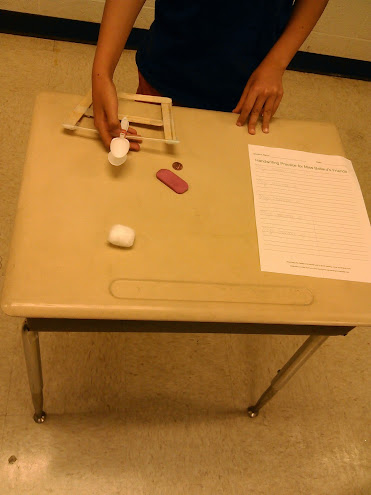
Well, here's an example, I asked this student about the logistics of her design and she explained to me that she got the idea from a seesaw. She described to me the way a seesaw works and pointed out the fact that since it works there, why not here...so cute!! Her grabber was able to pick up a cotton ball, a sheet of paper, an eraser and a penny!! 


This student said he came up with his idea after thinking about the motion of a person's hand moving up and down, while watching his mother cook dinner. He explained that he noticed a continuous up and down motion, that he wanted to immitate in his design. He also discussed the actual look of his design and how it lends itself to convenience and conveys the feel of a real hand. His grabber was able to pick up a cotton ball, a sheet of paper, an eraser and a penny as well!! 


Here are a few other designs!!

PhotoPhoto
Photo

The bottom line, challenge your little friends without having the end in sight. Let them find their way through observations made through success and failure!!! And as always...here's a link to the actual challenge, the specifics and a letter you can send home with a rubric attached!! :)
 
Your friend in STEM,
 
Thee Busy Bee